
No products in the cart.
Dyness Lithium Battery Guide: Which Model Fits Which Home? Leave a comment
A Dyness lithium battery comes in sizes from a small 12 V unit up to stackable commercial systems. However, the model names do not tell you much, so buyers often compare the wrong ones. Therefore, this guide sorts the Dyness range we stock by the kind of system each one fits.
Every Dyness lithium battery here uses LiFePO4 cells. In addition, the prices below come live from our store.
The Dyness lithium battery range at a glance
| AR1.2 | DL2.5 | DL5.0C | DL5.0F | PowerBrick Plus | |
|---|---|---|---|---|---|
| Price | Rs 63,000 | Rs 129,000 | Rs 228,000 | Rs 230,000 | Rs 585,000 |
| Voltage | 12.8 V | 25.6 V | 51.2 V | 51.2 V | 51.2 V |
| Energy | 1.28 kWh | 2.56 kWh | 5.12 kWh | 5.12 kWh | 16.08 kWh |
| Rated cycle life | 4,000 at 100% depth of discharge | 6,000 or more at 90% | 6,000 or more | 8,000 or more at 95% | 8,000 or more at 95% |
| Units you can connect | Up to 16 | Up to 16 | Up to 50 | Up to 50 | Up to 50 |
| Weight | About 10.5 kg | 23 kg | 54 kg | 41 kg | 119 kg |
| Protection rating | IP65 | IP20 | — | IP20 | IP65 |
| Warranty | 5 years | — | — | 10 years | 10 years |
A dash means the datasheet we hold does not give that figure. Therefore, ask us before ordering if it matters for your system.
Match the battery to your inverter voltage
First, check the battery voltage your inverter needs, because a Dyness lithium battery only works at its own voltage. You will find the figure on the inverter’s label and in its manual. A battery of the wrong voltage will not work, however good it is.
12 V inverters and UPS units: Dyness AR1.2
This model directly replaces a single 12 V lead-acid battery. It weighs about 10.5 kg, has an IP65 rating and carries a 5-year warranty. In addition, you can join up to 16 units in series or parallel, so two make a 24 V bank and four make 48 V.
24 V inverters: Dyness DL2.5
This 2.56 kWh unit suits the 24 V inverters common in the 3 kW class. Dyness rates it for 6,000 or more cycles at 90% depth of discharge. Also, you can connect up to 16 units for 40.96 kWh.
48 V hybrid inverters: Dyness DL5.0F or DL5.0C
Both store 5.12 kWh at 51.2 V, and both expand to 50 units. However, the DL5.0F is the newer design. It weighs 41 kg against 54 kg, and Dyness rates it for 8,000 or more cycles at 95% depth of discharge. In addition, it offers a maximum discharge current of 100 A and a 10-year warranty. Therefore, choose the DL5.0F unless you are adding to an existing DL5.0C bank.
Large homes and overnight AC: Dyness PowerBrick Plus
One unit stores 16.08 kWh, of which you can use 15.27 kWh. It charges and discharges at up to 200 A, and Dyness recommends 140 A for daily use. As a result, a single Dyness lithium battery of this size can carry the full output of a 6kW inverter. It has an IP65 rating, mounts on the floor or wall and includes a built-in aerosol fire extinguisher. However, at 119 kg it needs two people and a solid mounting point.
The PowerBrick SC and PowerBrick Max are 16.07 kWh versions with an IP20 rating for indoor installation.
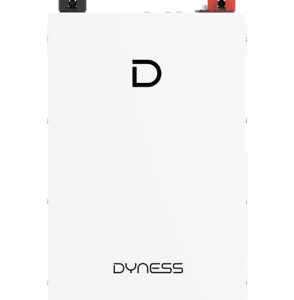 Dyness DL5.0F Lithium-Ion Battery - 51.2V 100AH IP20 5.12kWhRs 230,000View product
 Dyness PowerBrick Plus Lithium-Ion Battery - 51.2V 314AH IP65 16.08kWhRs 585,000View product
 Dyness PowerBrick SC 16.07kWh IP20 Lithium ion Battery 51.2V – 314Ah (With LCD)Rs 573,000View product
 Dyness PowerBrick Max 16.07kWh IP20 Lithium ion Battery 51.2V – 314AhRs 580,000View product
How long will a Dyness lithium battery run your home?
Divide the usable energy by your load. For example:
- DL5.0F with a 500 W evening load (fans, lights, fridge, TV): about 4.9 kWh usable ÷ 0.5 kW gives roughly 9 to 10 hours.
- PowerBrick Plus with the same load plus a 1.5 ton inverter AC drawing 1,730 W: 15.27 kWh ÷ 2.2 kW gives roughly 7 hours, and longer once the AC slows down.
Will a Dyness battery work with my inverter?
Dyness lists compatibility with GoodWe, Solis, SAJ, Growatt, Deye, Victron and other brands for its 48 V batteries. For example, the SAJ 6kW hybrid inverter takes a 48 V Dyness lithium battery. The battery and inverter communicate over CAN or RS485. Therefore, your installer has to select the right protocol at installation. Send us your inverter model and we will confirm before you order.
For businesses
The Dyness STACK100 is a stackable high-voltage system for commercial sites. Because it needs a high-voltage hybrid inverter, it does not fit a normal home system.
Common Dyness lithium battery questions
Can I add a second Dyness battery later?
Yes, because every 48 V Dyness lithium battery connects in parallel. However, add the second unit within a year or two if you can, so both batteries age together.
Can I mix DL5.0C and DL5.0F in one bank?
Ask us before doing this. In general, installers advise against mixing models with different cells and firmware in one bank.
Does IP20 mean I cannot install it outdoors?
Yes. IP20 units belong in dry indoor spaces. For a balcony, rooftop room or any place open to dust and moisture, choose an IP65 model instead.
Planning the rest of the system? Then read our guides to net metering in Pakistan and Jinko Tiger Neo panels.