
No products in the cart.
Jinko N-Type Tiger Neo Panels Explained: Are They Worth It? Leave a comment
The Jinko Tiger Neo is one of the best-known N-type solar panels in Pakistan. However, few sellers explain what the N-type label changes on your roof. Therefore, this post explains it with figures from the Jinko Tiger Neo datasheets, and then compares the 645 W and 720 W models we stock.
What N-type means in the Jinko Tiger Neo
A solar cell starts as silicon with a small amount of another element added. Older PERC panels use P-type silicon. In contrast, the Tiger Neo uses N-type silicon and a cell design called TOPCon. As a result, you get three advantages. Jinko Solar publishes all of the figures below in its datasheets.
1. Less power lost to heat
Every panel loses output as it gets hotter. The Tiger Neo loses 0.29% for each degree above 25°C, whereas P-type PERC panels typically lose around 0.35%. For example, on a summer rooftop where the cells reach 65°C, the Tiger Neo loses about 11.6% and a typical PERC panel loses about 14%. Because Pakistan has long, hot summers, this difference adds up every day.
2. Slower ageing
Jinko guarantees that the Tiger Neo loses no more than 1% in its first year and 0.40% a year after that. Therefore, the panel still delivers at least 87.4% of its rated power after 30 years. By comparison, PERC panels typically lose about 2% in the first year and a little more each year after.
3. More from the back of the panel
Both Jinko Tiger Neo models are bifacial, so the rear side also produces power from reflected light. Jinko rates the rear side at about 80% of the front. However, you only benefit if light can reach the back. For this reason, bifacial panels help on raised structures over a light-coloured roof and do little when panels sit flat against a dark surface.
Jinko Tiger Neo 645 W vs 720 W
| Tiger Neo 645W | Tiger Neo 720W | |
|---|---|---|
| Price | Rs 25,800 | Rs 30,240 |
| Model | JKM645N-66HL4M-BDV | JKM720N-66HL5-BDV |
| Efficiency | 23.9% | 23.18% |
| Operating current (Imp) | 15.57 A | 17.61 A |
| Short-circuit current (Isc) | 16.38 A | 18.67 A |
| Open-circuit voltage (Voc) | 50.08 V | 49.04 V |
| Size | 2382 × 1134 × 30 mm | 2384 × 1303 × 33 mm |
| Weight | 32.4 kg | 37.5 kg |
| Temperature coefficient | -0.29% per °C | -0.29% per °C |
| Warranty | 12 years product, 30 years power | 12 years product, 30 years power |
Which Tiger Neo panel to buy
Choose the 645 W if
- Your inverter’s MPPT inputs have a rating below 18 A. The 645 W panel runs at 15.57 A, so it suits almost every inverter.
- Your mounting structure fits the standard 1134 mm panel width.
- Your team has to carry panels up a staircase. At 32.4 kg, two people can manage one panel.
Choose the 720 W if
- Roof space is tight and you want the most power from each panel position.
- Your inverter accepts at least 18 A per MPPT input, and ideally 20 A.
- Your structure suits the wider 1303 mm frame and the 37.5 kg weight.
To compare value, divide each panel’s price by its wattage. Then choose the lower price per watt, provided that both panels fit your roof and inverter.
 Jinko Tiger Neo 645W N-Type Bifacial Solar PanelRs 25,800View productJinko Tiger Neo 720W N-Type Bifacial Solar PanelRs 30,240View product
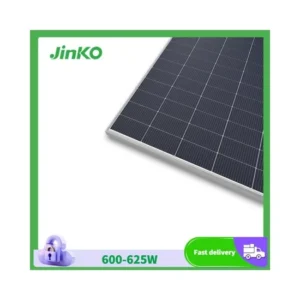 Jinko 610W N-type Bifical Solar PanelRs 29,250View product
 Jinko 585W N Type Bificial Solar PanelRs 29,250View product
Is the Jinko Tiger Neo worth the extra money?
For most rooftops in Pakistan, yes. Because of the lower heat loss and slower ageing, a Jinko Tiger Neo panel produces more units every year for the life of the system. In addition, its 30-year power warranty is longer than most PERC warranties. However, the case is weaker when a PERC panel is much cheaper per watt and you have plenty of roof space.
Before you size the array, also read our guide to net metering in Pakistan, because the new rules change how many panels pay off. For storage, see our Dyness lithium battery guide.
Common questions
Do bifacial panels need a special structure?
No. However, they produce more on a raised structure with open space behind them. Also, keep rails and cables away from the back of the cells where you can.
Can I mix 645 W and 720 W panels?
Not in the same string, because their currents differ. Instead, put each model on its own MPPT input.
How many Tiger Neo panels fit a 6kW hybrid inverter?
That depends on the inverter’s PV limits. As a guide, eight to twelve 645 W Jinko Tiger Neo panels split across two MPPT inputs suit most 6kW hybrids. Send us the inverter model and we will work out the string layout.