
No products in the cart.
How to Size a Battery Bank for Overnight Backup Leave a comment
This guide shows you how to size a battery bank for overnight backup. A battery that is too small leaves you in the dark at 3 am. However, one that is too big is money sitting unused on the wall. Because the method takes three numbers and about five minutes, this post walks through it with two worked examples.
Step 1: add up what must stay on
First, list the appliances you want running during a power cut and add their wattage. The rating plate on each appliance gives the figure. For example, typical values are:
| Appliance | Typical power |
|---|---|
| Ceiling fan | 60 to 80 W |
| LED light | 10 to 15 W |
| Fridge (averaged over the night) | 60 to 100 W |
| LED TV | 80 to 120 W |
| Wi-Fi router | 10 W |
| 1.5 ton inverter AC | 1,000 to 1,800 W |
Step 2: multiply by the hours
Then multiply the power in watts by the hours and divide by 1,000 to get units (kWh). For example, a 500 W load for 8 hours needs 4 kWh.
Step 3: size the battery bank for usable capacity
To size a battery bank correctly, never plan to run it down to zero every night. Therefore, divide the energy you need by the usable share of the battery:
- Lithium (LiFePO4): 90 to 95% usable, so divide by 0.9.
- Tubular lead-acid: about 50% usable if you want it to last, so divide by 0.5.
Example 1: size a battery bank for essentials only
Four fans, lights, a fridge, a TV and a router come to about 500 W. For 8 hours:
- First, the energy needed: 0.5 kW × 8 h = 4 kWh.
- Then the lithium battery size: 4 ÷ 0.9 = 4.4 kWh.
Therefore, one 5 kWh lithium battery covers it. For example, you can choose the Zilo Nexa 5kWh at Rs 200,000 or the Dyness DL5.0F at Rs 230,000.
Example 2: size a battery bank for essentials plus one AC
Now size a battery bank for the same home with a 1.5 ton inverter AC drawing up to 1,730 W for 6 hours:
- First, the essentials: 4 kWh.
- Then the AC: 1.73 kW × 6 h = 10.4 kWh.
- As a result, the total is 14.4 kWh.
- Finally, the lithium battery size: 14.4 ÷ 0.95 = 15.2 kWh.
That calls for a 16 kWh unit such as the Dyness PowerBrick Plus at Rs 585,000 or the Zilo Nexa Smart 16kWh at Rs 540,000. However, this is the worst case. An inverter AC slows down once the room is cool, so real use is lower.
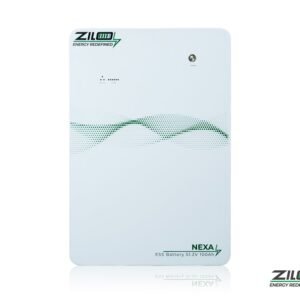 Zilo Nexa 5kWh 51.2V 100Ah Lithium BatteryRs 200,000View product
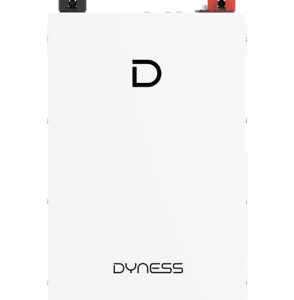 Dyness DL5.0F Lithium-Ion Battery - 51.2V 100AH IP20 5.12kWhRs 230,000View product
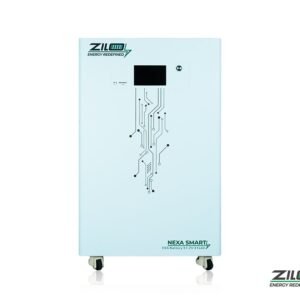 Zilo Nexa Smart 16kWh 51.2V 314Ah Lithium BatteryRs 540,000View product
 Dyness PowerBrick Plus Lithium-Ion Battery - 51.2V 314AH IP65 16.08kWhRs 585,000View product
Step 4: check the battery can deliver the power
Capacity tells you how long a battery lasts, whereas discharge current tells you how much it can run at once. For example, a 48 V battery with a 50 A limit can supply about 2.5 kW. Similarly, one with a 100 A limit can supply about 5 kW.
If your peak load during a cut is higher than the battery’s limit, the inverter will trip even though the battery is full. Therefore, fix this with a second battery in parallel or a larger single unit. For example, Dyness rates the PowerBrick Plus for 140 A in daily use, which is about 7 kW.
Step 5: make sure you can refill it
A battery is only useful if it is full by evening. As a rule of thumb, you need about 1 kW of panels for every 4 kWh of battery you want to fill each day. In addition, you need the panels that run your daytime load. Otherwise, a 16 kWh battery behind a small array will never be full.
Smaller systems
The same steps apply when you size a battery bank for 12 V and 24 V inverters. However, the battery itself changes.
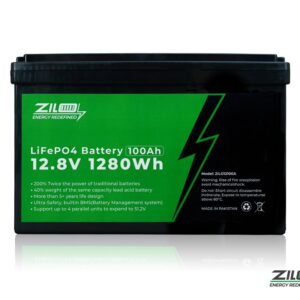 Zilo 12V Nexa Cube 12.8V 100Ah Lithium BatteryRs 52,000View product
 DYNESS LITHIUM ION BATTERY 12.8V 100AHRs 63,000View product
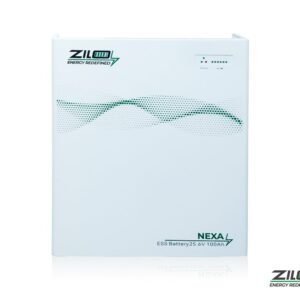 Zilo Nexa 2.5kWh 24V Lithium Battery (25.6V 100Ah)Rs 120,000View product
 Dyness DL2.5 2.56kWh IP20 Lithium Battery 25.6V 100AhRs 129,000View product
Common questions
How many tubular batteries equal one 5 kWh lithium battery?
About four 12 V tubular batteries of 185 Ah, used down to half charge, give the same usable energy as one 5 kWh lithium battery. For more detail, see our lithium vs tubular battery comparison.
Should I size a battery bank for the longest power cut of the year?
No. Instead, size for a normal bad day, not the worst day. On the rare longer outage, switch off the AC and then the battery will last through the night on essentials.
Can I start with one battery and add another?
Yes, because you can connect the lithium batteries above in parallel. However, add the second within a year or two so both age together.
Tell us which appliances you want to keep running and for how long. Then we will size a battery bank for you and check it against your inverter. Also, our Dyness lithium battery guide compares the models by size.