
No products in the cart.
Battery Cable Size and DC Breaker for a Lithium Battery Leave a comment
Battery cable size is the most overlooked part of a solar installation. The battery and inverter get all the attention. However, a thin cable between them wastes power, heats up and can trip the system. Therefore, size the cable and its breaker with the same care as the battery itself.
Step 1: find the current to design for
Look at two figures: the battery’s maximum continuous current and the inverter’s maximum battery current. Then design the battery cable size for the lower of the two, because that is the most the cable will ever carry.
| Product | Maximum battery current |
|---|---|
| Dyness DL5.0F | 100 A discharge |
| Dyness PowerBrick Plus | 200 A, with 140 A recommended |
| SAJ 6kW hybrid inverter | 120 A |
| Sungrow 6kW hybrid inverter | 135 A |
| GoodWe 6kW hybrid inverter | 140 A |
For example, a DL5.0F on the SAJ inverter can pass 100 A at most, since the battery is the lower figure.
Step 2: choose the battery cable size
The table below shows the battery cable size installers commonly use for short runs of copper cable. However, treat it as a guide, and follow the battery and inverter manuals where they state a size.
| Design current | Typical copper cable | Typical DC breaker |
|---|---|---|
| Up to 50 A | 16 mm² | 63 A |
| Up to 100 A | 35 mm² | 125 A |
| Up to 150 A | 50 mm² | 175 to 200 A |
| Up to 200 A | 70 mm² | 250 A |
Step 3: choose the DC breaker
The breaker protects the cable. As a rule of thumb, choose one rated about 25% above the design current, so it does not trip in normal use. In addition, it must be a DC breaker, because an AC breaker cannot safely break a battery fault.
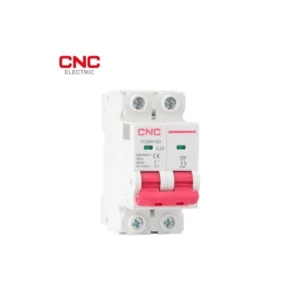
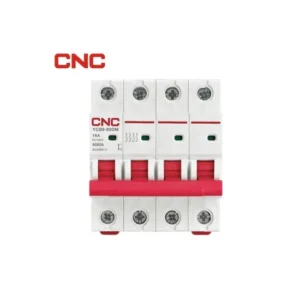
Check the ampere rating and voltage rating of any breaker before you order it.
Battery cable size mistakes to avoid
- Long runs: keep the battery close to the inverter, because every extra metre loses voltage.
- Unequal lengths: in a parallel bank, use the same length for each battery, so they share current evenly.
- Poor lugs: crimp lugs properly, since a loose lug heats up under load.
- Aluminium or thin welding cable: use proper copper cable instead.
- No breaker: never connect a battery without protection.
Signs the cable is too thin
Warm cable, warm terminals, or an inverter that trips when a heavy load starts all point to a battery cable size that is too small. Our guide on how to size a battery bank covers the battery side of the same problem. Makers such as Dyness also state cable requirements in their manuals.
Common questions
Does battery cable size matter for a short one-metre run?
Yes, because the current is high. However, a short run lets you stay at the lower end of the range.
Can I use two thinner cables in place of one thick one?
Installers sometimes do this. However, both cables must be the same length and share one properly rated lug or busbar.
Should the breaker go on the positive or the negative?
A two-pole DC breaker switches both. Therefore, it is the safer choice for a battery.