
No products in the cart.
Solar Tubewell: Panels and VFD for 3, 5 and 10 HP Motors Leave a comment
A solar tubewell runs a pump straight from panels, with no diesel and no bill. However, the system only works well when the panels, the drive and the motor match. Therefore, this guide shows how to size each part for the motors farmers use most.
How a solar tubewell works
Panels make DC power. A solar pump inverter, also called a VFD, turns it into three-phase AC and adjusts the motor’s speed to the sunlight available. As a result, the pump starts gently in the morning, runs fastest at noon and slows towards evening. There is no battery, because the water itself is the storage.
Step 1: convert horsepower to kilowatts
Motor labels show horsepower, whereas drives and panels use kilowatts. One horsepower is about 0.75 kW.
| Motor | Motor power | Panel capacity | 645 W panels | Drive size |
|---|---|---|---|---|
| 3 HP | 2.2 kW | 3.3 to 4.4 kW | 6 to 7 | 4 kW |
| 5 HP | 3.7 kW | 5.6 to 7.4 kW | 9 to 12 | 4 or 5.5 kW |
| 7.5 HP | 5.5 kW | 8.3 to 11 kW | 13 to 17 | 5.5 or 7.5 kW |
| 10 HP | 7.5 kW | 11.3 to 15 kW | 18 to 23 | 7.5 or 11 kW |
Step 2: size the panels
Panels rarely give full power, and a pump needs extra at start-up. Therefore, installers fit a solar tubewell with one and a half to two times the motor’s power in panels. The lower figure suits a shallow bore, whereas a deep bore or long hours need the higher one.
Step 3: choose the VFD
Pick a solar tubewell drive rated at or just above the motor’s power. In addition, check that it suits your motor type. The drives below are for standard three-phase motors.
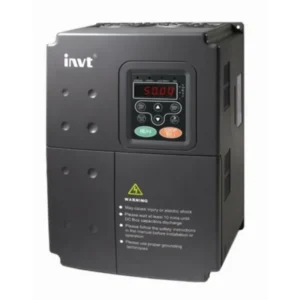 INVT VFD 4/5.5 kW 3 PhaseRs 55,000View product
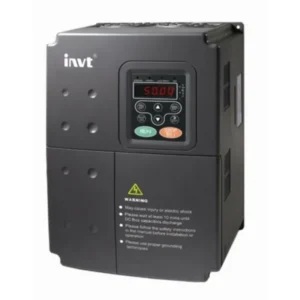 INVT VFD 5.5/7.5 kW 3 PhaseRs 56,000View product
 SAJ VFD Drive 7.5 KW Solar Pump InverterRs 60,000View product
 SAJ VFD Drive 11 KW Solar Pump InverterRs 79,000View product
The SAJ solar pump inverters include dry-well protection through a low-level switch, and they accept a generator as backup. So the pump stops safely if the water level falls.
Step 4: match the string voltage
Every solar tubewell drive needs its panels wired to a set DC voltage range. Because this depends on the drive model and the motor voltage, send us both and we will design the strings.
Why a solar tubewell uses a tank, not a battery
Storing water costs far less than storing electricity. Therefore, pump into a tank or pond during the day and then irrigate when you need to. A battery adds cost without adding water.
What decides the water you get
Four things decide how much water a solar tubewell delivers:
- Depth of the water table: a deeper bore needs more power for the same flow.
- Delivery pipe: a narrow or long pipe wastes pressure, so size it properly.
- Season: summer days give more pumping hours than winter days.
- Panel cleanliness: dust cuts output, so rinse the panels often.
For the panels themselves, see our Jinko Tiger Neo guide. Panel datasheets are available from Jinko Solar.
 Jinko Tiger Neo 645W N-Type Bifacial Solar PanelRs 25,800View product
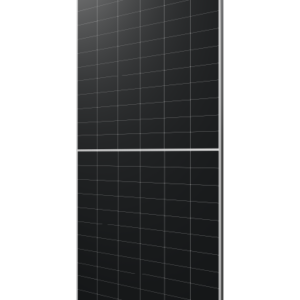 Longi Hi-MO X10 645W Bifacial Solar PanelRs 27,300View product
Common questions
Can a solar tubewell run my existing motor?
Usually yes, if it is a standard three-phase motor in good condition. However, a single-phase motor needs a different drive, so tell us what you have.
Does a solar tubewell work on cloudy days?
It pumps less, because the drive slows the motor to match the light. Therefore, a storage tank matters.
Can I run the tubewell at night?
Not from panels. However, the SAJ drives accept a generator, and some farms keep a grid connection for night use.